Pakistan’s solar industry is going through one of its biggest policy changes in years. After the rapid growth of rooftop solar systems and net metering installations across the country, the government has now started shifting toward a new model called net billing.
For thousands of homeowners already using solar panels and for those planning to install a solar system in Pakistan this change has created confusion, concern, and many questions.
Will net metering end completely?
Is solar still worth installing in Pakistan?
How will net billing affect electricity savings?
And most importantly, what should homeowners do now?
In this guide, we’ll explain the difference between net metering and net billing in simple terms, how the new policy works, what it means for solar users in Pakistan, and whether solar remains a smart investment in 2026.
The recent changes were introduced under NEPRA’s updated prosumer regulations, which separate imported and exported electricity billing instead of adjusting units one-to-one like the older net metering system.
Why Pakistan Is Moving From Net Metering to Net Billing
Over the last few years, solar adoption in Pakistan increased rapidly because electricity prices kept rising while solar panel prices became more affordable.
For many households, net metering made rooftop solar highly attractive because excess solar electricity exported to the grid was adjusted almost equally against imported units. This allowed users to recover solar investment costs relatively quickly.
However, the government and power sector regulators argued that the old net metering structure was putting financial pressure on the electricity system. According to the revised framework, exported electricity will now be compensated separately at a lower rate under a net billing mechanism.
This policy shift is designed to:
- reduce pressure on the national grid,
- limit subsidy imbalance,
- encourage self-consumption of solar electricity,
- and create a new compensation structure for rooftop solar users.
What Is Net Billing?
Net billing is a solar billing system where:
- Electricity imported from the grid is charged at the normal electricity tariff.
- Electricity exported from your solar system is purchased separately by the utility company at a lower predefined buyback rate.
This is different from traditional net metering, where exported units were adjusted directly against consumed units.
Under the new system, imported and exported electricity are treated separately instead of being balanced unit-for-unit.
Net Billing vs Net Metering in Pakistan
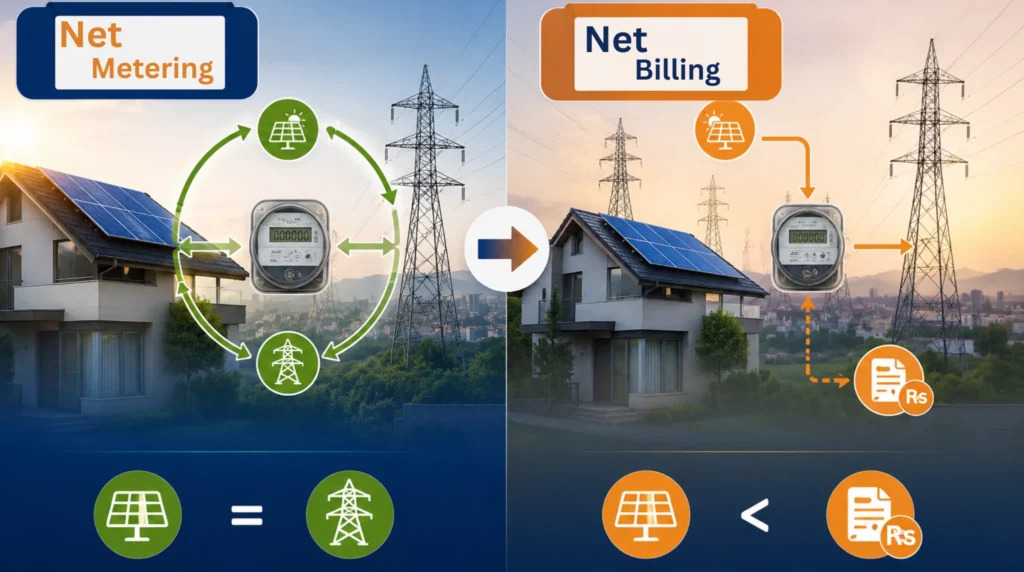
Here’s the easiest way to understand the difference.
| Feature | Net Metering | Net Billing |
| Exported solar units | Adjusted against imported units | Purchased separately |
| Export value | Near retail electricity rate | Lower buyback rate |
| Electricity bill savings | Higher | Lower compared to old system |
| Solar ROI | Faster recovery | Longer payback period |
| Best for | Export-heavy systems | Self-consumption-focused systems |
Under older net metering rules, many households could offset daytime exported electricity against nighttime usage almost equally.
With net billing, exported electricity is compensated at a lower rate while imported electricity is still charged at full retail tariff.
How Net Billing Will Affect Solar Users in Pakistan
The impact depends largely on how your solar system is designed and how much electricity you consume during the daytime.
For homes that export large amounts of electricity back to the grid, the change could reduce overall monthly savings compared to older net metering arrangements. However, households that consume most of their solar electricity during the day may still benefit significantly because self-consumed solar energy directly replaces expensive grid electricity.
In practical terms, this means:
- solar systems now need smarter sizing,
- daytime electricity usage becomes more important,
- and battery backup solutions may become more valuable in the future.
Is Solar Still Worth It After Net Billing?
Yes – solar is still worth it in Pakistan.
But the strategy has changed.
Earlier, many homeowners installed larger systems mainly to export extra electricity and maximize net metering benefits. Under net billing, oversized systems may no longer provide the same financial advantage.
Now the focus is shifting toward:
- efficient system sizing,
- maximizing self-consumption,
- reducing daytime grid dependence,
- and improving energy backup reliability.
Even with lower export compensation, solar still helps reduce electricity bills significantly because grid electricity tariffs in Pakistan remain extremely high and continue to increase almost every year.
For many households, solar is no longer just about investment returns. It is also about:
- protection from rising electricity costs,
- reduced load shedding dependence,
- energy independence,
- and long-term stability.
Why This Change Matters More in Pakistan
Pakistan’s electricity environment is very different from many other countries.
Homeowners regularly deal with:
- high electricity tariffs,
- fuel adjustment charges,
- taxes and surcharges,
- load shedding,
- unstable power supply,
- and unpredictable billing increases.
That is one of the biggest reasons solar adoption accelerated so quickly across cities like Lahore, Karachi, Islamabad, Faisalabad, and Multan.
Even after the transition toward net billing, rooftop solar remains one of the few practical long-term solutions for controlling electricity expenses.
Existing Net Metering Users vs New Solar Users
One of the biggest concerns among solar consumers is whether existing net metering users will lose their current agreements.
According to the updated regulations and policy discussions, existing approved agreements are expected to continue under previous terms until their contract duration expires, while new applicants will follow the updated net billing structure.
This distinction is extremely important because it affects:
- future solar ROI,
- system sizing decisions,
- and investment planning.
What Type of Solar System Makes More Sense Now?
Under the new policy environment, properly designed solar systems matter more than ever.
Instead of installing oversized systems mainly for export purposes, homeowners should now focus on systems optimized around actual electricity usage patterns.
For example:
- homes using electricity heavily during daytime hours can still achieve strong savings,
- businesses operating during working hours may benefit significantly,
- and hybrid solar systems with battery storage may become increasingly attractive.
This is why load analysis and professional solar consultation are becoming more important than simply installing the largest possible system.
Should Homeowners Rush to Install Solar?
Many people in Pakistan are now wondering whether they should install solar immediately before more policy changes happen.
The reality is that every homeowner’s situation is different.
Factors like:
- monthly electricity bill,
- roof space,
- daytime usage,
- future expansion plans,
- and backup requirements
all play a major role in deciding the right system.
However, one thing is clear: Pakistan’s electricity costs are unlikely to decrease significantly anytime soon, and solar continues to remain one of the strongest long-term alternatives for homeowners and businesses looking for predictable energy costs.
The Future of Solar in Pakistan
Despite policy changes, Pakistan’s solar market is still expected to grow rapidly.
The country has already seen massive growth in rooftop solar adoption because:
- solar panel prices became more affordable,
- electricity tariffs increased sharply,
- and people increasingly want energy independence.
The shift toward net billing may slow export-focused solar investments, but it will likely encourage:
- smarter solar system design,
- better energy management,
- battery storage adoption,
- and self-consumption optimization.
In many ways, Pakistan’s solar market is entering a more mature stage.
Final Thoughts
The shift from net metering to net billing marks a major transition for Pakistan’s solar industry.
While the economics of exported electricity have changed, solar energy still remains a practical and valuable investment for many households and businesses dealing with rising electricity costs.
The biggest difference now is that system design matters more than ever.
Instead of focusing only on exporting excess electricity, homeowners should prioritize:
- efficient system sizing,
- daytime energy usage,
- and long-term energy independence.
As electricity prices continue rising across Pakistan, solar power is still expected to play a major role in helping consumers reduce reliance on the grid and manage long-term electricity expenses.
FAQs About Net Billing in Pakistan
What is net billing in Pakistan?
Net billing is a solar billing mechanism where imported and exported electricity are calculated separately. Exported solar electricity is purchased at a lower buyback rate instead of being adjusted unit-for-unit like traditional net metering.
What is the difference between net metering and net billing?
Net metering adjusts exported electricity directly against imported units, while net billing separately charges imported electricity and compensates exported electricity at a lower rate.
Is net metering ending in Pakistan?
Pakistan is gradually shifting toward a net billing framework under updated NEPRA regulations for new solar users. Existing approved agreements may continue under earlier terms until contract expiry.
Is solar still worth it after net billing?
Yes. Solar still helps reduce electricity bills, especially for households and businesses that consume most of their electricity during daytime hours.
Will net billing reduce solar savings?
Compared to older net metering rules, export-related savings may reduce because exported electricity is compensated at a lower rate.
Should I install a hybrid solar system now?
Hybrid solar systems may become more valuable under net billing because they allow homeowners to store excess electricity in batteries instead of exporting large amounts to the grid.
Why did the government introduce net billing?
The government introduced net billing to reduce pressure on the electricity system and create a different compensation structure for exported solar electricity.
What type of homes benefit most from solar after net billing?
Homes with higher daytime electricity consumption generally benefit more because they directly use solar electricity instead of exporting large amounts back to the grid.